Reference
GATE DA syllabus & exam guide
Every unit and topic, with how much of the exam it's actually worth, plus the exam mechanics themselves. Use this to decide where an hour of practice pays off most, not just what's left unread.
About the GATE DA exam
How the paper splits
Question types & marking
Multiple Choice Question
One correct option out of four. Wrong answers cost −1/3 mark (1-mark questions) or −2/3 mark (2-mark questions).
Multiple Select Question
One or more correct options out of four; the exact set is required for credit. No negative marking.
Numerical Answer Type
Type in a numeric value on a virtual keypad -- no options are shown. No negative marking.
Who can appear, and what it's worth
Since GATE 2023 there's no separate minimum-qualification gate to clear first -- it's open to anyone pursuing or holding a degree in Engineering, Technology, Architecture, Science, Commerce or Arts, including final-year students who haven't graduated yet.
- Admission to M.Tech / MS (Research) / direct PhD programmes at IITs, NITs, IIITs and other centrally funded institutes -- most of which also carry a monthly stipend for admitted scholars.
- Direct recruitment by a number of Public Sector Undertakings (PSUs) -- companies like BHEL, ONGC, IOCL, NTPC and BARC hire straight off GATE scores instead of running their own written exam.
- A growing number of universities abroad (Germany's DAAD-linked programmes and a few others in Singapore) accept a strong GATE score toward certain postgraduate admissions.
Strategy
The Under-100 Ranker's Guide
Not everything is studied equally — high-weightage concepts, PYQ mastery and disciplined revision, run on a repeatable weekly cycle. PYQs are the single most important resource; everything else exists to make PYQ mastery possible.
The core loop
Step 1
Solve cold
Step 2
Autopsy the miss
Step 3
Log it
Step 4
Re-solve later
Priority order
🔥 Highest priority
- Engineering Mathematics
- General Aptitude
- Programming & Data Structures
- Algorithms
- DBMS
- Operating Systems
- Computer Networks
- Computer Organization & Architecture
📌 Then master
- Theory of Computation
- Compiler Design
- Digital Logic
Daily & weekly rhythm
| Time | Activity |
|---|---|
| 2 hr | Learn / revise concepts |
| 2 hr | ⭐ PYQ practice |
| 1 hr | Questions / test |
| 1 hr | Revision + error notebook |
PYQ rules
Solve & understand
Solve blind
Solve under pressure
Mock test ramp
The revision system
📕 Mistake book
📗 Formula / concept book
📘 Difficult PYQ list
Final 60 days
The Under-100 mindset
Measure preparation by PYQs mastered, accuracy %, questions solved under time, repeated mistakes eliminated and mock-test performance — not hours studied.
Golden rule
For an AIR under 100 in GATE CSE, PYQs are not practice after preparation — PYQs are the preparation.
Reference
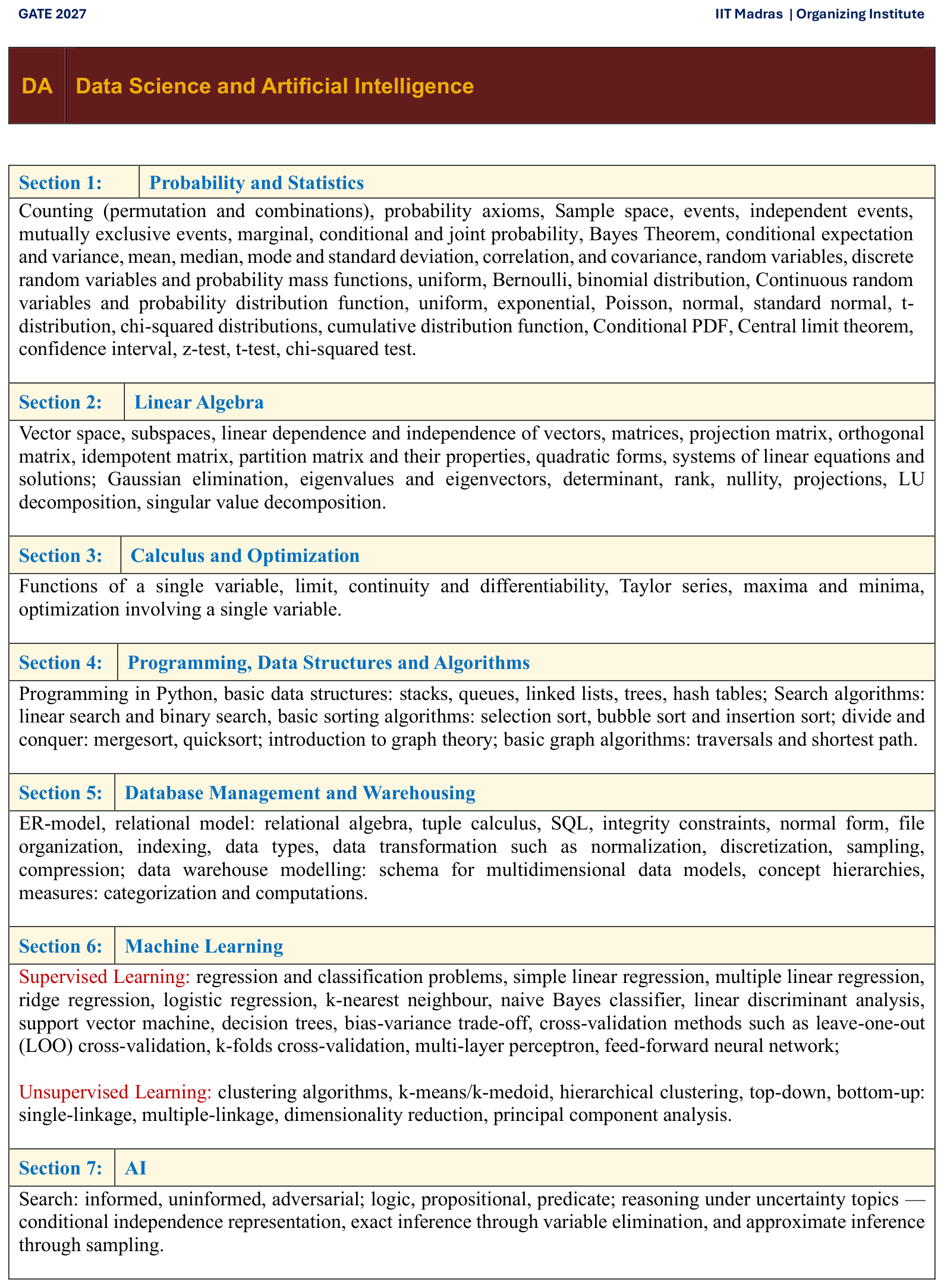
Official PDF & Changes
The exact document GATE DA bases its paper on, plus what's different from last year's syllabus so a returning aspirant knows exactly what to re-check.
GATE 2027
GATE 2027 DA syllabus (PDF)
Why you should appear
Your route into an M.Tech, MS (Research) or direct PhD programme at an IIT, NIT or IISc — with a monthly stipend attached.
M.Tech & research opportunities
COAP
IITs & IISc
Common Offer Acceptance Portal -- IITs and IISc Bangalore run joint M.Tech/MS(R) admissions through it, seat-matching across your GATE score and preferences.
CCMT
NITs, IIITs & GFTIs
Centralized Counselling for M.Tech/M.Plan -- the equivalent single-window process for NITs, IIITs and other centrally funded institutes.
Institute-specific
Direct PhD
Most IITs also accept a strong GATE score in place of a separate written entrance test for direct PhD admission -- apply straight to the department.
Section 1
Probability and Statistics
| Topic | Importance | Priority | Focus areas | |
|---|---|---|---|---|
| Counting & Probability Basics |
7.5
|
Medium-High | Permutations & combinations, probability axioms, sample space, independent & mutually exclusive events | Not in bank yet |
| Conditional Probability & Bayes Theorem |
8.5
|
High | Marginal, conditional & joint probability, Bayes' theorem, conditional expectation and variance | Not in bank yet |
| Descriptive Statistics |
7.0
|
Medium-High | Mean, median, mode, standard deviation, correlation and covariance | Not in bank yet |
| Discrete Random Variables & Distributions |
8.0
|
High | Random variables, PMF, uniform, Bernoulli and binomial distributions | Not in bank yet |
| Continuous Random Variables & Distributions |
8.5
|
High | PDF, uniform, exponential, Poisson, normal, standard normal, t- and chi-squared distributions, CDF, conditional PDF | Not in bank yet |
| Statistical Inference |
8.0
|
High | Central limit theorem, confidence intervals, z-test, t-test, chi-squared test | Not in bank yet |
Section 2
Linear Algebra
| Topic | Importance | Priority | Focus areas | |
|---|---|---|---|---|
| Vector Spaces & Matrix Properties |
7.5
|
Medium-High | Vector space, subspaces, linear dependence/independence, projection, orthogonal, idempotent and partition matrices, quadratic forms | Not in bank yet |
| Systems of Linear Equations & Gaussian Elimination |
7.5
|
Medium-High | Systems of linear equations and their solutions, Gaussian elimination | Not in bank yet |
| Eigenvalues, Rank & Determinants |
8.5
|
High | Eigenvalues & eigenvectors, determinant, rank, nullity, projections | Not in bank yet |
| Matrix Decompositions |
7.5
|
Medium-High | LU decomposition, singular value decomposition | Not in bank yet |
Section 3
Calculus and Optimization
| Topic | Importance | Priority | Focus areas | |
|---|---|---|---|---|
| Single-Variable Calculus |
6.0
|
Medium | Functions of a single variable, limit, continuity and differentiability, Taylor series | Not in bank yet |
| Optimization |
6.5
|
Medium | Maxima and minima, optimization involving a single variable | Not in bank yet |
| Topic | Importance | Priority | Focus areas | |
|---|---|---|---|---|
| Python Programming Basics |
7.0
|
Medium-High | Core Python programming | Not in bank yet |
| Core Data Structures |
8.0
|
High | Stacks, queues, linked lists, trees, hash tables | Not in bank yet |
| Searching & Sorting |
7.5
|
Medium-High | Linear search, binary search, selection sort, bubble sort, insertion sort | Not in bank yet |
| Divide and Conquer |
7.5
|
Medium-High | Mergesort, quicksort | Not in bank yet |
| Graph Theory & Algorithms |
8.0
|
High | Introduction to graph theory, traversals, shortest path | Not in bank yet |
Section 5
Database Management and Warehousing
| Topic | Importance | Priority | Focus areas | |
|---|---|---|---|---|
| ER & Relational Model |
7.5
|
Medium-High | ER-model, relational algebra, tuple calculus, SQL, integrity constraints, normal form | Not in bank yet |
| File Organization & Indexing |
6.5
|
Medium | File organization, indexing, data types | Not in bank yet |
| Data Transformation |
7.0
|
Medium-High | Normalization, discretization, sampling, compression | Not in bank yet |
| Data Warehouse Modelling |
7.0
|
Medium-High | Schema for multidimensional data models, concept hierarchies, measures: categorization and computation | Not in bank yet |
Section 6
Machine Learning
| Topic | Importance | Priority | Focus areas | |
|---|---|---|---|---|
| Regression |
8.5
|
High | Simple linear regression, multiple linear regression, ridge regression | Not in bank yet |
| Classification |
8.5
|
High | Logistic regression, k-nearest neighbour, naive Bayes classifier, linear discriminant analysis | Not in bank yet |
| SVM & Decision Trees |
8.0
|
High | Support vector machine, decision trees | Not in bank yet |
| Model Evaluation |
8.0
|
High | Bias-variance trade-off, leave-one-out cross-validation, k-folds cross-validation | Not in bank yet |
| Neural Networks |
8.0
|
High | Multi-layer perceptron, feed-forward neural network | Not in bank yet |
| Clustering |
8.0
|
High | k-means/k-medoid, hierarchical clustering (single-linkage, multiple-linkage) | Not in bank yet |
| Dimensionality Reduction |
7.5
|
Medium-High | Principal component analysis | Not in bank yet |
Section 7
AI
| Topic | Importance | Priority | Focus areas | |
|---|---|---|---|---|
| Search Techniques |
7.5
|
Medium-High | Informed, uninformed and adversarial search | Not in bank yet |
| Logic |
7.0
|
Medium-High | Propositional logic, predicate logic | Not in bank yet |
| Reasoning Under Uncertainty |
8.0
|
High | Conditional independence, exact inference via variable elimination, approximate inference via sampling | Not in bank yet |
Every GATE paper
General Aptitude
Verbal Aptitude
English grammar, sentence completion, verbal analogies, word groups, instructions, critical reasoning, verbal deduction
Quantitative Aptitude
Data interpretation, numerical computation, numerical estimation, numerical reasoning
Analytical Aptitude
Logic, deduction, analytical reasoning
Spatial Aptitude
Transformation of shapes, assembling/grouping, paper folding, rotation and pattern recognition