Reference
GATE CSE syllabus & exam guide
Every unit and topic, with how much of the exam it's actually worth, plus the exam mechanics themselves. Use this to decide where an hour of practice pays off most, not just what's left unread.
About the GATE CSE exam
How the paper splits
Question types & marking
Multiple Choice Question
One correct option out of four. Wrong answers cost −1/3 mark (1-mark questions) or −2/3 mark (2-mark questions).
Multiple Select Question
One or more correct options out of four; the exact set is required for credit. No negative marking.
Numerical Answer Type
Type in a numeric value on a virtual keypad -- no options are shown. No negative marking.
Who can appear, and what it's worth
Since GATE 2023 there's no separate minimum-qualification gate to clear first -- it's open to anyone pursuing or holding a degree in Engineering, Technology, Architecture, Science, Commerce or Arts, including final-year students who haven't graduated yet.
- Admission to M.Tech / MS (Research) / direct PhD programmes at IITs, NITs, IIITs and other centrally funded institutes -- most of which also carry a monthly stipend for admitted scholars.
- Direct recruitment by a number of Public Sector Undertakings (PSUs) -- companies like BHEL, ONGC, IOCL, NTPC and BARC hire straight off GATE scores instead of running their own written exam.
- A growing number of universities abroad (Germany's DAAD-linked programmes and a few others in Singapore) accept a strong GATE score toward certain postgraduate admissions.
Strategy
The Under-100 Ranker's Guide
Not everything is studied equally — high-weightage concepts, PYQ mastery and disciplined revision, run on a repeatable weekly cycle. PYQs are the single most important resource; everything else exists to make PYQ mastery possible.
The core loop
Step 1
Solve cold
Step 2
Autopsy the miss
Step 3
Log it
Step 4
Re-solve later
Priority order
🔥 Highest priority
- Engineering Mathematics
- General Aptitude
- Programming & Data Structures
- Algorithms
- DBMS
- Operating Systems
- Computer Networks
- Computer Organization & Architecture
📌 Then master
- Theory of Computation
- Compiler Design
- Digital Logic
Daily & weekly rhythm
| Time | Activity |
|---|---|
| 2 hr | Learn / revise concepts |
| 2 hr | ⭐ PYQ practice |
| 1 hr | Questions / test |
| 1 hr | Revision + error notebook |
PYQ rules
Solve & understand
Solve blind
Solve under pressure
Mock test ramp
The revision system
📕 Mistake book
📗 Formula / concept book
📘 Difficult PYQ list
Final 60 days
The Under-100 mindset
Measure preparation by PYQs mastered, accuracy %, questions solved under time, repeated mistakes eliminated and mock-test performance — not hours studied.
Golden rule
For an AIR under 100 in GATE CSE, PYQs are not practice after preparation — PYQs are the preparation.
Track-specific notes
Top Priority Scoring Units
Discrete Mathematics, Data Structures & Programming, Theory of Computation, and Operating Systems offer high return on investment (predictable question patterns and high aggregate marks).
Formula & Numerical Intensive Units
Computer Organization (Pipelining & Cache), Computer Networks (Sliding Window Protocols, Subnetting, TCP Congestion Control), and Digital Logic (Sequential Circuits).
High Accuracy Theory Units
Databases (Transactions, Normalization) and Compiler Design (Parsers, Syntax Directed Translation).
Reference
Official PDF & Changes
The exact document GATE CSE bases its paper on, plus what's different from last year's syllabus so a returning aspirant knows exactly what to re-check.
GATE 2027
GATE 2027 CS & IT syllabus (PDF)
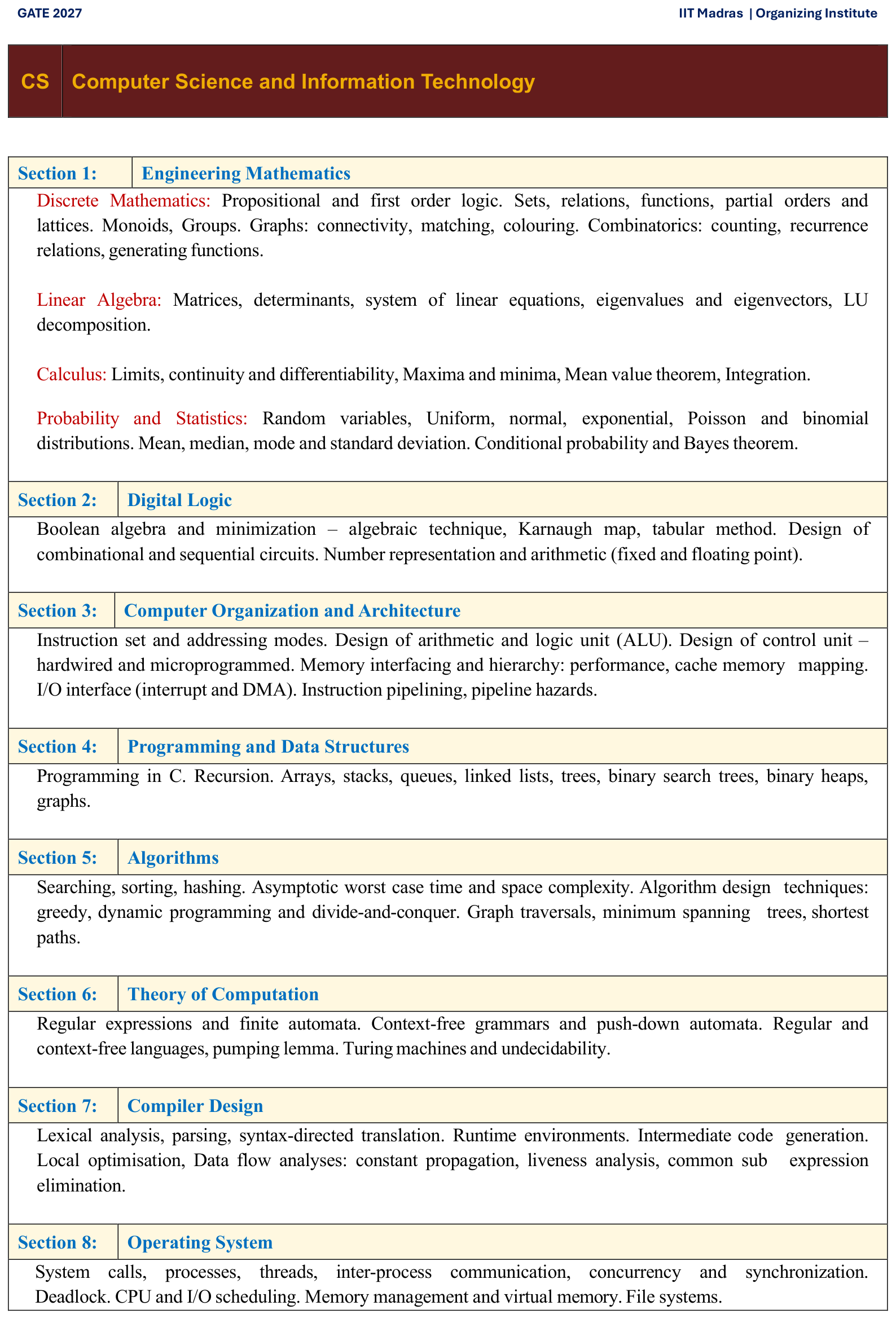
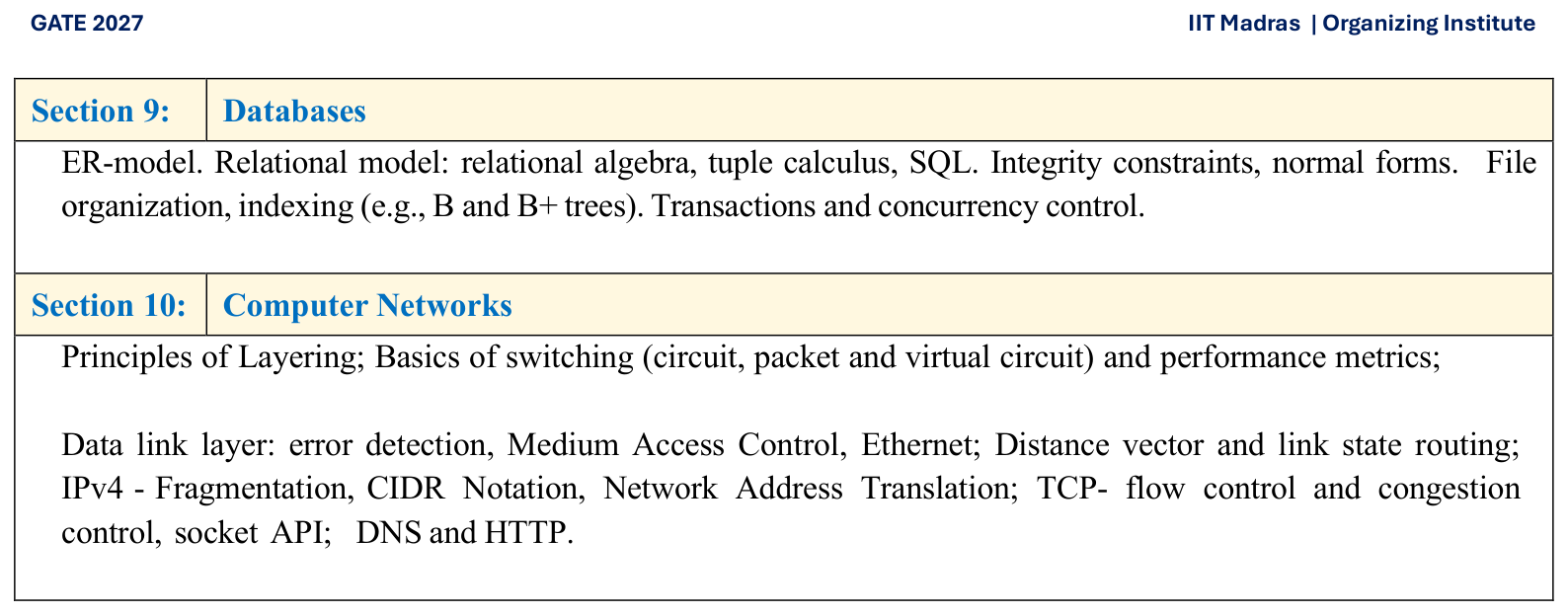
What's changed — GATE 2026 → GATE 2027
Digital Logic
- reworded “Minimization” is now spelled out as “algebraic technique, Karnaugh map, tabular method” instead of standing alone as one word -- same scope, named more specifically.
Computer Organization and Architecture
- reworded Control unit design now explicitly names the two approaches -- “hardwired and microprogrammed” -- instead of just “control unit”.
- reworded Memory coverage shifts from naming the hierarchy's tiers (“cache, main memory and secondary storage”) to naming “performance” and “cache memory mapping” instead.
Computer Networks
- added “Performance metrics” is added alongside the switching basics.
- removed Explicit mention of the OSI and TCP/IP protocol stacks is dropped -- now just “Principles of Layering”.
- removed Data link layer: “framing” and “Ethernet bridging” are no longer named, leaving “error detection, Medium Access Control, Ethernet”.
- removed Routing: “shortest path” and “flooding” are dropped, leaving only “distance vector and link state routing”.
- removed “Basics of IP support protocols (ARP, DHCP, ICMP)” is removed entirely.
- removed Transport layer: UDP is no longer named (TCP-only), and “sockets” is now “socket API”.
- removed Application layer: SMTP, FTP and Email are dropped, leaving only “DNS and HTTP”.
Why you should appear
One exam, two very different doors: a straight-to-job route through PSU recruitment, and a straight-to-postgrad route into an IIT or NIT. A single good score opens both.
PSU recruitment through GATE
Bharat Heavy Electricals Ltd
Oil & Natural Gas Corporation
Indian Oil Corporation Ltd
NTPC Limited
Bharat Electronics Ltd
Power Grid Corporation of India
GAIL (India) Ltd
Steel Authority of India Ltd
Hindustan Aeronautics Ltd
NHPC Limited
Hindustan Petroleum Corporation Ltd
Bhabha Atomic Research Centre
Coal India Limited
Nuclear Power Corporation of India
M.Tech & research opportunities
COAP
IITs & IISc
Common Offer Acceptance Portal -- IITs and IISc Bangalore run joint M.Tech/MS(R) admissions through it, seat-matching across your GATE score and preferences.
CCMT
NITs, IIITs & GFTIs
Centralized Counselling for M.Tech/M.Plan -- the equivalent single-window process for NITs, IIITs and other centrally funded institutes.
Institute-specific
Direct PhD
Most IITs also accept a strong GATE score in place of a separate written entrance test for direct PhD admission -- apply straight to the department.
Unit I
Engineering Mathematics
| Topic | Importance | Priority | Focus areas | |
|---|---|---|---|---|
| Mathematical Logic |
9.5
|
High | Propositional & First Order Logic, Quantifiers, Validity, Equivalence | |
| Set Theory and Algebra |
8.5
|
Medium-High | Relations, Equivalence, Partial Orders, Lattices, Groups | |
| Combinatorics |
9.0
|
High | Counting Principles, Pigeonhole Principle, Recurrence Relations, Generating Functions | |
| Graph Theory |
9.5
|
High | Connectivity, Planarity, Coloring, Matching, Euler & Hamiltonian Paths | |
| Probability |
9.0
|
High | Conditional Probability, Bayes' Theorem, Random Variables, Distributions, Expectation | |
| Linear Algebra |
9.0
|
High | Eigenvalues & Eigenvectors, Matrix Rank, Systems of Linear Equations, Determinants | |
| Calculus |
7.0
|
Medium | Limits, Continuity, Differentiability, Maxima and Minima |
Unit II
Theory of Computation
| Topic | Importance | Priority | Focus areas | |
|---|---|---|---|---|
| Finite Automata: Regular Languages |
9.5
|
High | DFA, NFA, Regular Expressions, Minimization, Closure Properties, Pumping Lemma | |
| Push Down Automata: CFL & DCFL |
9.0
|
High | Context-Free Grammars, Ambiguity, DPDA vs NPDA, Closure Properties | |
| Turing Machine: RE, REC and Undecidability |
9.0
|
High | Decidability Table, Halting Problem, Rice's Theorem, Chomsky Hierarchy |
Unit III
Digital Logic
| Topic | Importance | Priority | Focus areas | |
|---|---|---|---|---|
| Logic Functions and Minimization |
8.0
|
Medium | Boolean Algebra, K-Maps, Essential Prime Implicants, Canonical Forms | |
| Combinational Circuits |
9.0
|
High | Multiplexers (MUX implementation), Decoders, Encoders, Adders | |
| Sequential Circuits |
8.5
|
Medium-High | Flip-Flops, Synchronous & Asynchronous Counters, State Diagrams, Propagation Delay | |
| Number Systems |
7.5
|
Medium | 2's Complement, Overflow Conditions, Base Conversions, Fixed/Floating point basics |
Unit IV
Computer Organization
| Topic | Importance | Priority | Focus areas | |
|---|---|---|---|---|
| CPU Architecture & Addressing Modes |
8.5
|
Medium-High | Instruction Formats, Effective Address Calculations, RISC vs CISC | |
| Control Unit Design |
7.0
|
Medium | Hardwired vs Microprogrammed Control Units, Micro-instruction Formats | Not in bank yet |
| Instruction Pipelining |
9.5
|
High | Pipeline Hazards (Structural, Data, Control), Speedup, CPI, Stalls, Branch Penalties | |
| Memory Organization |
9.5
|
High | Cache Mapping (Direct, Associative, Set-Associative), Hit Rate, Average Access Time | Not in bank yet |
| IO Organization |
8.0
|
Medium | DMA Transfer Modes (Burst, Cycle Stealing), Interrupt Handling |
| Topic | Importance | Priority | Focus areas | |
|---|---|---|---|---|
| Programming |
9.5
|
High | C Language (Pointers, Recursion, Parameter Passing, Scope, Storage Classes) | |
| Arrays |
8.0
|
Medium | 1D & 2D Array Address Mapping (Row/Column Major), Basic Operations | |
| Stacks and Queues |
9.0
|
High | Infix/Prefix/Postfix Conversions, Stack Evaluation, Circular Queues, Applications | |
| Linked List |
8.5
|
Medium-High | Singly, Doubly, Circular Linked Lists, Pointer Manipulations, Loop Detection | |
| Trees |
9.5
|
High | Binary Search Trees (BST), AVL Trees, Tree Traversals, Heap & Priority Queues | |
| Graphs |
9.0
|
High | BFS, DFS, Graph Representations, Topological Sorting | Not in bank yet |
| Hashing |
8.5
|
Medium-High | Collision Resolution (Chaining, Linear/Quadratic Probing, Double Hashing) |
Unit VI
Algorithms
| Topic | Importance | Priority | Focus areas | |
|---|---|---|---|---|
| Algorithm Analysis & Asymptotic Notations |
9.5
|
High | Big-O, Theta, Omega, Master Theorem, Recursive Equations | |
| Divide and Conquer |
9.0
|
High | Merge Sort, Quick Sort, Binary Search, Median Finding | |
| Greedy Method |
9.0
|
High | MST (Kruskal & Prim), Dijkstra's Algorithm, Huffman Coding, Fractional Knapsack | |
| Dynamic Programming |
9.0
|
High | 0/1 Knapsack, LCS, Matrix Chain Multiplication, Bellman-Ford, Floyd-Warshall | |
| P and NP Concepts |
7.5
|
Medium | P, NP, NP-Complete, NP-Hard, Reductions (Theoretical identification) | Not in bank yet |
| Miscellaneous Topics |
6.5
|
Low-Medium | Linear-time sorting (Count, Radix, Bucket), Lower bounds | Not in bank yet |
Unit VII
Compiler Design
| Topic | Importance | Priority | Focus areas | |
|---|---|---|---|---|
| Lexical Analysis |
8.0
|
Medium | Token Count, Regular Expressions for Tokens, Lexical Errors | |
| Parsing Techniques |
9.5
|
High | FIRST & FOLLOW, LL(1), LR(0), SLR(1), CLR(1), LALR(1), Conflict Resolution | |
| Syntax Directed Translation |
8.5
|
Medium-High | S-Attributed & L-Attributed Definitions, Annotated Parse Trees, Intermediate Code | Not in bank yet |
| Code Generation & Optimization |
8.0
|
Medium | Basic Blocks, Flow Graphs, DAG representation, Common Subexpression Elimination |
Unit VIII
Operating Systems
| Topic | Importance | Priority | Focus areas | |
|---|---|---|---|---|
| Process Management-I |
9.0
|
High | CPU Scheduling Algorithms (FCFS, SJF, SRTF, Round Robin), Threads, Context Switching | |
| Process Management-II |
9.5
|
High | Critical Section, Semaphores, Mutex, Classical IPC Problems (Producer-Consumer, Readers-Writers) | |
| Deadlock |
9.0
|
High | Deadlock Conditions, Resource Allocation Graphs, Banker's Algorithm, Deadlock Prevention | |
| Memory Management & Virtual Memory |
9.5
|
High | Paging, Multi-level Paging, Segmentation, TLB, Page Replacement Algorithms (FIFO, LRU, Optimal) | |
| File System & Device Management |
8.0
|
Medium | File Allocation Methods, Inode Structure, Disk Scheduling (SSTF, SCAN, C-SCAN) | |
| Miscellaneous |
6.5
|
Low-Medium | System Calls (fork, exec), Protection & Security basics | Not in bank yet |
Unit IX
Database Management
| Topic | Importance | Priority | Focus areas | |
|---|---|---|---|---|
| ER-Model |
7.5
|
Medium | Entity Types, Relationships, Cardinality & Participation, ER to Relational Schema Conversion | |
| Database Design: FDs and Normalization |
9.5
|
High | Candidate Keys, 1NF, 2NF, 3NF, BCNF, Lossless Join Decomposition, Dependency Preservation | |
| Structured Query Language (SQL) |
9.0
|
High | Nested Subqueries, Joins, GROUP BY / HAVING, Aggregation, NULL value semantics | Not in bank yet |
| Relational Model: Relational Algebra & TRC |
8.5
|
Medium-High | Relational Algebra Operations (Selection, Projection, Joins, Division), Tuple Relational Calculus | |
| Transactions & Concurrency Control |
9.5
|
High | ACID Properties, Conflict/View Serializability, Recoverability, Two-Phase Locking (2PL), Timestamp Ordering | |
| File Structures |
8.5
|
Medium-High | B-Trees & B+ Trees (Node capacity calculations, Order, Insertion/Deletion) |
Unit X
Computer Networks
| Topic | Importance | Priority | Focus areas | |
|---|---|---|---|---|
| ISO/OSI Stack and SWP |
9.0
|
High | Layer functionalities, Sliding Window Protocols (Stop & Wait, Go-Back-N, Selective Repeat, Efficiency calculations) | |
| LAN |
8.5
|
Medium-High | Ethernet frame format, CSMA/CD, Minimum frame size calculations, Exponential Backoff | Not in bank yet |
| TCP, UDP and IP |
9.5
|
High | IPv4 Addressing & Subnetting (CIDR), Fragmentation, TCP Congestion Control, Flow Control, Header formats | |
| Routing and Application Layer |
8.5
|
Medium-High | Distance Vector Routing, Link State Routing, DNS, DHCP, HTTP, SMTP |
Every GATE paper
General Aptitude
Verbal Aptitude
English grammar, sentence completion, verbal analogies, word groups, instructions, critical reasoning, verbal deduction
Quantitative Aptitude
Data interpretation, numerical computation, numerical estimation, numerical reasoning
Analytical Aptitude
Logic, deduction, analytical reasoning
Spatial Aptitude
Transformation of shapes, assembling/grouping, paper folding, rotation and pattern recognition